







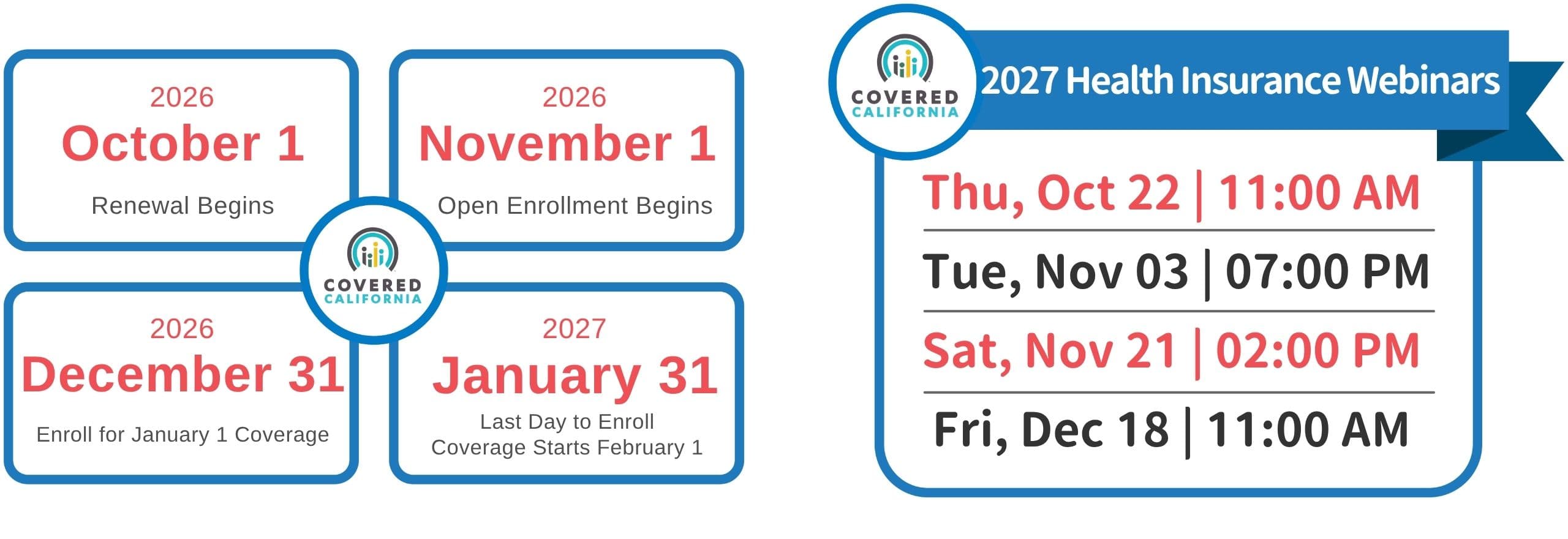
Open Enrollment for 2027 California individual and family health plans begins November 1, 2026. For existing policyholders, Open Enrollment is the ideal time to review options, compare rates, and consult with specialists to find the right coverage and premium for 2027 while deciding whether to adjust your policy. In 2027, Covered California continues to offer a broad selection of insurance carriers and plan options. Depending on income and eligibility, financial assistance and subsidies may significantly reduce costs, with qualifying plans available for as low as $0 premium and $0 deductible. For those who are currently uninsured or experiencing a change in visa or immigration status, Open Enrollment is your essential annual opportunity to secure comprehensive health coverage in California.
2027 California Health Insurance: Rising Premiums, Subsidy Changes, and Updated Eligibility Rules. Are You Ready?
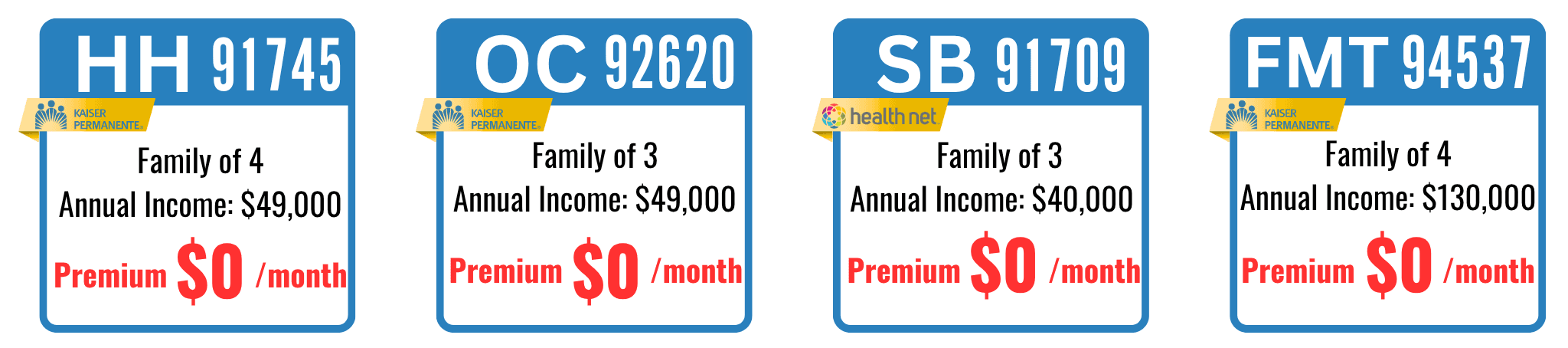
Low Income Rate Samples
Low Income Individual and Family Insurance Plan Benefits
U.S. citizens and tax residents can apply for government subsidized health insurance. Because premiums and subsidy amounts are directly tied to household size and annual reported income, and open enrollment only occurs during a limited three month window each year, having a licensed and experienced insurance agent is essential to securing the best coverage, the lowest premiums, and the most accurate subsidies and tax credits. Individuals and families with reported annual incomes between 138 percent and 250 percent of the Federal Poverty Level may qualify for highly affordable Silver 94, Silver 87, and Silver 73 enhanced plans.
- Benefit Category
- Price
- Silver 94
- $
- Silver 87
- $$
- Silver 73
- $$$
- Benefit Category
- Popularity
- Silver 94
- ★★★★☆
- Silver 87
- ★★★☆☆
- Silver 73
- ★★★☆☆
- Benefit Category
- Medical Deductible
- Silver 94
- Individual: $200
Family: $400 - Silver 87
- Individual: $1,100
Family: $2,200 - Silver 73
- Individual: $4,700
Family: $9,400
- Benefit Category
- Primary Care Visit
- Silver 94
- $5
- Silver 87
- $15
- Silver 73
- $50
- Benefit Category
- Specialty Care Visit
- Silver 94
- $8
- Silver 87
- $30
- Silver 73
- $100
- Benefit Category
- Laboratory Tests
- Silver 94
- $10
- Silver 87
- $35
- Silver 73
- $50
- Benefit Category
- Pharmacy Deductible
- Silver 94
- $0
- Silver 87
- Individual: $50
Family: $100 - Silver 73
- Individual: $50
Family: $100
- Benefit Category
- Inpatient Hospital Care
- Silver 94
- 10%*
- Silver 87
- 20%*
- Silver 73
- 30%*
- Benefit Category
- Outpatient Surgery
- Silver 94
- 10%
- Silver 87
- 20%
- Silver 73
- 30%
- Benefit Category
- Annual Out-of-Pocket Maximum
- Silver 94
- Individual: $3,000
Family: $6,000 - Silver 87
- Individual: $4,000
Family: $8,000 - Silver 73
- Individual: $9,600
Family: $19,200
- Benefit Category
- Benefit Details
- Silver 94
- View Details (opens in new tab)
- Silver 87
- View Details (opens in new tab)
- Silver 73
- View Details (opens in new tab)
- Benefit Category
- Benefits Explained Video
- Silver 94
- View Video (opens in new tab)
- Silver 87
- View Video (opens in new tab)
- Silver 73
- View Video (opens in new tab)
*You must pay the full cost of medical services until your medical deductible is met before copayments apply. Drug pricing is based on a 30 day supply.
Note: All annual benefits, deductibles, and out of pocket maximums are calculated on a calendar year basis, ending on December 31. The information above is provided for basic benefit reference only. Please review your official policy document for exact coverage terms and conditions.
Basic Insurance Plan Benefits
| Benefit Category | Bronze 60 | Silver 70 | Gold 80 | Platinum 90 | Bronze HDHP | Minimum Coverage (Under 30 Years Old)** |
|---|---|---|---|---|---|---|
| Price | $ | $$ | $$$ | $$$$ | $ | $ |
| Popularity | ★★★★☆ | ★★★★★ | ★☆☆☆☆ | ★★★☆☆ | ★★★☆☆ | ★★★★★ |
| Medical Deductible | Individual: $5,800 Family: $11,600 | Individual: $4,700 Family: $9,400 | $0 | $0 | Individual: $7,800 Family: $15,600 | Individual: $12,000 Family: $24,000 |
| Annual Wellness Exam | $0 | $0 | $0 | $0 | $0 | $0 |
| Primary Care Visit | $60 | $50 | $40 | $20 | In-Network Covered Services Paid at 100% After Out-of-Pocket Maximum | $0*③ |
| Specialist Care Visit | $100*③ | $100 | $80 | $45 | In-Network Covered Services Paid at 100% After Out-of-Pocket Maximum | |
| Laboratory Tests | $50 | $50 | $40 | $25 | ||
| Outpatient Surgery | 40% | 30% | $225 copay / 30% co-insurance | $100 copay / 10% co-insurance | ||
| Inpatient Hospital Care | 40%* | 30%* | $375/day / 30% co-insurance | $325/day / 10% co-insurance | ||
| Annual Out-of-Pocket Maximum | Individual: $11,650 Family: $23,300 | Individual: $11,650 Family: $23,300 | Individual: $9,600 Family: $19,200 | Individual: $5,500 Family: $11,000 | Individual: $7,800 Family: $15,600 | Individual: $12,000 Family: $24,000 |
| Benefit Details | View Details (opens in new tab) | View Details (opens in new tab) | View Details (opens in new tab) | View Details (opens in new tab) | View Details (opens in new tab) | View Details (opens in new tab) |
| Benefits Explained Video | View Video (opens in new tab) | View Video (opens in new tab) | View Video (opens in new tab) | View Video (opens in new tab) | View Video (opens in new tab) | View Video (opens in new tab) |
* You must pay the full allowed amount for this medical service until you meet your medical deductible. After the deductible is met, the applicable copayment applies.
*③ The copayment applies to the first three eligible office visits per year. After the third visit, you must pay the full allowed amount for this medical service until you meet your medical deductible. Once the deductible is met, the applicable copayment applies again. Benefits and applicable copayments depend on the diagnosis codes submitted by your in-network provider to the insurance company. Different diagnosis codes may result in different copayments. Please refer to your plan’s Evidence of Coverage. The information above provides a general summary of benefits for reference only. Please carefully review your policy terms before using your benefits.
** Minimum Coverage Plans are available to individuals under age 30. These plans are not eligible for premium assistance through Covered California.
Note: Annual benefits, deductibles, and annual out-of-pocket maximums are calculated on a calendar-year basis, ending on December 31.
Featured Leading Health Insurance Partners

Health Insurance FAQs
The public charge rule changed on September 18, 2026. Individuals applying for a green card or considering future naturalization should confirm whether using subsidized Covered California will impact their immigration application. Immigration officers evaluate an applicant's age, health, income, household status, and record of receiving specific public benefits. Covered California has removed disclosures stating that its coverage is exempt from public charge determinations. Please do not assume your status or rush to cancel your health insurance. Before applying for or renewing Covered California, consult a qualified immigration attorney to review your specific situation.
Yes. Under California law, individual healthcare mandate penalties have been fully reinstated since 2020. If you do not maintain minimum essential coverage, the California Franchise Tax Board will assess a penalty on your individual or household annual state tax return. Currently, the penalty for not having health insurance is at least $950 per adult per year and at least $450 per child under age 18 per year. For example, a family of four could face a minimum penalty of $2,800 per year.
The 2027 Covered California Open Enrollment period runs from November 1, 2026, through January 31, 2027. Individual health insurance can only be purchased or changed during this annual window, known as the Open Enrollment period. Once Open Enrollment ends, you will not be able to buy or switch individual health insurance plans unless you qualify for a special circumstance.
With 2027 premiums growing at an average of 9.9% and Silver plan deductibles increasing, families face higher costs if pandemic era subsidies expire.
Policyholders can lower costs by switching from PPO to HMO plans, moving to a lower metal tier, or pairing Bronze plans with a Health Savings Account for tax savings.
Contributing to a Traditional IRA also lowers your reported household income, helping you qualify for higher premium subsidies and better coverage.
The 2027 Covered California Open Enrollment period runs from November 1, 2026, through January 31, 2027.
To have your new plan take effect on January 1, 2027, you must complete your application by December 31, 2026. To have your new plan take effect on February 1, 2027, you must complete your application between January 1, 2027, and January 31, 2027.
The 2027 health insurance Open Enrollment period runs from November 1, 2026, through January 31, 2027. If you miss Open Enrollment, you cannot buy health insurance unless you apply within 60 days of one of the following qualifying life events:
Adding a child, having a newborn, taking in a foster child, or adopting a child
Losing minimum essential coverage because an employer stops offering group health insurance for you or your dependents, excluding voluntary COBRA termination
Losing Medi-Cal coverage due to an increase in household income
Becoming a permanent resident of California or moving into the state to establish permanent residency
Without an SSN , you cannot apply for most health insurance plans used by U.S. residents. Standard travel insurance often does not cover routine medical needs , and pre-existing conditions such as diabetes, high blood pressure, or pregnancy are frequently excluded. For seniors 65 and older , not having an SSN also means you cannot apply for federal Medicare .
But don’t worry! In this situation, you can contact KCAL Insurance , and we will help you find the best health insurance plan based on your needs and circumstances, ensuring reliable and comprehensive coverage so you can confidently handle all your healthcare challenges.Click here to call KCAL Insurance Agency
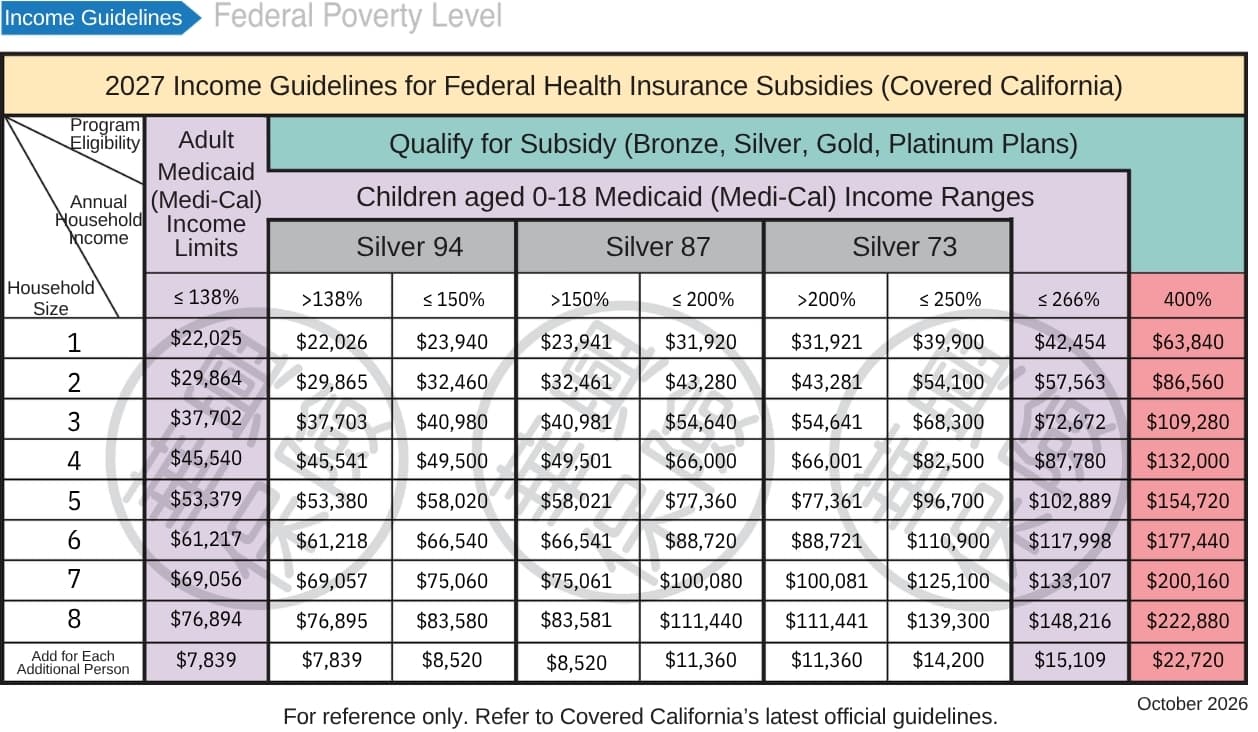
The Covered California system connects directly with the IRS, using household size, annual household income from Form 1040, and residential region as primary criteria to calculate health plan premiums and eligible government financial help. U.S. citizens and green card holders whose income meets subsidy qualifications can receive premium assistance and cost sharing reductions.
The following table outlines eligibility for federal government subsidies. If your annual household income meets Federal Poverty Level guidelines, the government provides three distinct types of financial assistance based on your income bracket: Medi-Cal, premium assistance, and cost sharing reductions.
Please prepare your most recent Form 1040 tax return, using lines 2a, 6a, and 11 Adjusted Gross Income as the primary reference.
If you have pay stubs, rental income, interest income, or EDD statements, these can also serve as proof to estimate your total annual income.
If you do not have supporting documentation, you can ask your accountant or employer to provide a signed income statement on your behalf.
If an applicant receives non-taxable Social Security benefits, foreign income earned while living abroad, or tax-exempt interest income, these must also be included to calculate your correct Modified Adjusted Gross Income.
*For specific tax inquiries, please consult your accountant.
If you wish to apply for a subsidized health insurance plan during the Open Enrollment period, you cannot voluntarily cancel Medi-Cal to purchase subsidized coverage.
You must bring your proof of income to your local county office to cancel your Medi-Cal benefits before applying for standard health insurance.
You cannot apply for subsidized health insurance without officially canceling your Medi-Cal coverage. However, if you do not require government subsidies, you can purchase an unsubsidized health plan during Open Enrollment while processing your Medi-Cal cancellation.
Because of ongoing changes from the pandemic, American health insurance underwent significant reforms. Following the signing of the American Rescue Plan, the individual health insurance market in California experienced three major adjustments. First, policyholders who received excess government premium subsidies in 2020 due to higher actual income were no longer required to repay those subsidies during tax filing. Second, Covered California policyholders became eligible to receive increased premium financial assistance. Third, families previously disqualified from premium subsidies due to higher income levels gained the opportunity to reevaluate their eligibility and purchase subsidized, more affordable health insurance plans.
PPO plan premiums continue to rise year after year. If you are in good health and require infrequent doctor visits, switching to an HMO plan can be a practical option to lower your monthly costs.
You can also open and contribute to a Traditional IRA to reduce the household annual income you report when applying for government financial help, which allows you to qualify for higher subsidies, lower your overall premiums, or even upgrade to a plan with better coverage benefits.
If your current doctor does not have a contract with your existing insurance carrier, you can switch to an insurance company that contracts with your physician during the Open Enrollment period.
If your primary care physician only accepts small group employer health plans, and you are a 1099 self employed individual or a business owner, even with as few as two employees, you are welcome to contact KCAL Insurance Agency for a consultation.
When plan benefits are identical within the same coverage tier, selecting an insurance carrier comes down to service quality, brand reputation, and the size of the provider network.
If you prefer convenient care and want to avoid treatment delays caused by network restrictions, Kaiser Permanente is an excellent choice. Its integrated healthcare model, comprehensive system, and fully equipped facilities eliminate the hassle of coordinating between different doctors and facilities.
If your employer offers group health insurance, you and your family members generally cannot receive government premium subsidies through Covered California if the employer plan meets federal affordability standards. If you apply for and receive premium financial assistance while having access to affordable employer coverage, all subsidies received must be repaid to the government during tax filing.
However, if your share of the premium for self only coverage exceeds the federal affordability threshold, or if adding your dependents makes family coverage unaffordable under current regulations, you or your family members may qualify for subsidized individual plans. If you choose to opt out without qualifying for subsidies, you can still purchase an unsubsidized individual plan during Open Enrollment.
“COVERED CALIFORNIA,” “CALIFORNIA HEALTH BENEFIT EXCHANGE”, AND THE COVERED CALIFORNIA LOGO ARE REGISTERED TRADEMARKS OR SERVICE MARKS OF COVERED CALIFORNIA, IN THE UNITED STATES.
This website is owned and maintained by KCAL Insurance Agency, which is solely responsible for its content. This site is not maintained by or affiliated with Covered California, and Covered California bears no responsibility for its content. The e-mail addresses and telephone number that appears throughout this site belong to KCAL Insurance Agency and cannot be used to contact Covered California.